Tuesday, November 9, 2010

BOB DYLAN


Bob Dylan has been a major figure in music for five decades. He pioneered several  schools of songwriting, from confessional singer/songwriter to winding, hallucinatory, stream-of-consciousness narratives. He broke down the notion that a singer must have a conventionally good voice in order to perform, redefining the vocalist's role in popular music. 

He evolved in the 60s as a chronicler and reluctant figurehead of social unrest. His songs became anthems for the US civil rights and anti-war movements. His lyrics incorporated a variety of political, social, philosophical, and literary influences. Starting out as a folk singer inspired by Woody Guthrie, Robert Johnson, and Hank Williams his music evolved into electric rock and roll, fusing poetry and music into his own ever-changing style. His work has incorporated folk, blues, country, gospel, rock and roll, jazz, swing, and Irish folk music. His influence is incalculable on all of the folk and rock music that has come after. 

Bob Dylan moved to New York City in 1961, hoping to perform and visit his idol Woody Guthrie, who was seriously ill with Huntington's Disease. Dylan played at the various clubs around in Greenwich Village and received positive reviews from Robert Shelton of the New York Times after a show at Gerde's Folk City. He came to the attention of the producer John Hammond who signed him to a contract with Columbia Records.

His first album simply called Bob Dylan, consisted of familiar folk, blues, and gospel material along with two original compositions. He did a version of House of the Rising Sun and wrote his tribute to Guthrie with Song To Woody. The album didn't do well and the jazz producer Tom Wilson was brought in to work on his second album.


The Freewheelin' Bob Dylan was released in May, 1963. Many of the songs were labeled protest songs, inspired by Guthrie and Pete Seeger. Oxford Town was a sardonic account of James Meredith's ordeal as the first black student to risk enrollment at the University of Mississippi. It also included his most famous song at that time Blowin' In The Wind which took its melody from a traditional slave song while its lyrics questioned the social and political status quo. A Hard Rain's a-Gonna Fall contained veiled references to nuclear apocalypse, and gained more resonance with the Cuban Missile Crisis. It also marked an important new direction in modern songwriting, by combining traditional folk with stream-of-consciousness and imagist lyrics. The album also contained love songs and jokey, surreal talking blues. Masters of War is a great song that made a powerful anti-war statement.


Dylan's third album, The Times They Are a-Changin' reflected a more politicized and cynical artist. The songs took their content from contemporary real life stories. Only A Pawn In Their Game addressed the murder of civil rights worker Medgar Evers. The Lonesome Death of Hattie Carroll was about the death of the black barmaid at the hands of a young white socialite.

Around this time Dylan was supposed to be on the Ed Sullivan Show singing Talkin' John Birch Paranoid Blues, but the producers of the show were worried about legal issues, so Dylan refused to appear rather than comply with censorship.

Another Side of Bob Dylan came out in 1964, and had a lighter mood than its predecessor. The surreal, humorous Dylan was reflected on I Shall Be Free #10 and Motorpsycho Nightmare. Spanish Harlem Incident and To Ramona are passionate and romantic love songs. Black Crow Blues and I Don't Believe You suggest  the rock and roll soon to enter Dylan's music. It Ain't Me Babe is on the surface a song about spurned love, but can also be seen as Dylan's rejection of the role his reputation had thrust at him. My Back Pages attacks the seriousness of his earlier topical songs and seems to predict the backlash he was about to encounter as he took a new direction. The incredible Chimes of Freedom sets elements of social commentary against a denser metaphorical landscape in a style Allen Ginsberg would call - chains of flashing images.


In 1965, Dylan made a huge stylistic leap with Bringing It All Back Home, featuring his first recordings with electric instruments. Subterranean Homesick Blues owed much to Chuck Berry's Too Much Monkey Business. Its free association lyrics contained the manic energy of Beat poetry and was forerunner of rap and hip-hop. It also had an early music video that came out of  D. A. Pennebaker's cinema verite presentation of Dylan's 1965 tour of England, Don't Look Back. The B Side consisted of four long songs on which Dylan accompanied himself on acoustic guitar and harmonica. Mr. Tambourine  Man became one of Dylan's best known songs when The Byrds recorded an electric version that reached the top of the charts. One of my favorite Dylan songs is on this album - It's Alright Ma (I'm Only Bleeding) where the stream-of-consciousness lyrics are delivered in a continuous flow. He who is not busy being born is busy dying.


Also in 1965, He performed at the Newport Folk Festival with his electric band that included Mike Bloomfield and Al Kooper. The crowd became hostile, and this performance provoked a negative response from the folk rock establishment. Some people saw this move in an electric direction as selling out, but Dylan was just wanted to go in a new direction and the next two albums - Highway 61 Revisited and Blonde on Blonde are now considered two of his best.


In July 1965, Dylan released Like A Rolling Stone. At over 6 minutes in length, the song is credited with altering attitudes about what a pop single could convey. Bruce Springsteen, in his speech during Dylan's inauguration into the Rock and Roll Hall of Fame, said that on first hearing the single, that "the snare shot sounded like somebody'd kicked open the door to your mind." Rolling Stone listed it as the number one of The 500 Greatest Songs of All Time. He also released the single Positively 4th Street about this time which was full of angry lyrics and widely interpreted as Dylan's response to his former friends in the folk community. It can also be seen as reflecting his bitterness towards a past lover.

Like A Rolling Stone was the first song on Highway 61 Revisited, titled after the road that lead from Dylan's Minnesota home to the musical hotbed of New Orleans. Most of the songs were flavored by Mike Bloomfield's blues guitar and Al Kooper's organ riffs. There is an intensity on this album, and includes the dark and powerful Ballad of a Thin Man. Desolation Row offers the sole acoustic exception, with Dylan making surreal allusions to a variety of figures in Western culture. The song takes the form of a Fellini-esque parade of grotesques and oddities featuring a huge cast of iconic characters, some historical, some biblical, some fictional, some literary, and some who don't fit into any category.


Blonde on Blonde was released in 1966 and inverted the garage rock sound of Highway 61. It blended blues, country, rock, and folk into a wild, careening, and dense sound. Robbie Robertson played an intense, weaving guitar and the Hawks were the backing band. It is made up of songs driven by inventive, surreal, and witty wordplay, not only on the rockers but also on the moving ballads like Visions of Johanna, Just Like A Woman, and Sad Eyed Lady of the Lowlands. Blonde on Blonde is an album of enormous depth, providing endless lyrical and musical revelations. The music is filled with cutting guitar riffs, liquid organ sounds, crisp piano, and even a woozy brass band on Rainy Day Women #12 & 35. It's the culmination of Dylan's electric rock and roll period - he would never release a studio record that rocked this hard, or contained such bizzare imagery.

In July 1966, Dylan had a motorcycle accident near his home in Woodstock, New York. The extent of his injuries were never disclosed, but after the accident he withdrew from the public and only appeared at  a few select appearances for the next several years.

In the Fall of 1967, Dylan returned to the studio and recorded John Wesley Harding, a quiet, more contemplative record of shorter songs that drew its imagery from the American West and The Bible. All Along The Watchtower took its lyrics from the Book of Isaiah, and of course was later recorded by Jimi Hendrix, which Dylan felt was the definitive version.

His next release in 1969 was Nashville Skyline, which was a straight country album, featuring Nashville musicians, a mellow-voiced Dylan, a duet with Johnny Cash, and a hit single - Lay Lady Lay.

Dylan's work became more varied and unpredictable in the 70s. He appeared live at the Concert For Bangladesh that was put together by George Harrison. He put out a few albums with New Morning probably being the strongest, and acted and made music for the film Pat Garrett and Billy Kid. One of his greatest and most emotional songs Knockin' On Heaven's Door came from these sessions. He also produced a live album with The Band called Before The Flood.


My favorite album from the 70s was Blood On The Tracks. It achieved a sublime balance between his earlier stream-of-consciousness work, and the simpler compostions of his post-accident years. It is an honest account of a love affair, with the stunning and moving song Tangled Up In Blue as its centerpiece.

Also around this time The Basement Tapes album was released, which were recordings Dylan had made with The Band in 1968. The work had previously been available as a bootleg. It is a truly American album as it gets into the weirdness inherent in old folk, country, and blues tunes. It is lively and humorous and has full bodied performances. 

Desire came out in 1975, and contained the song Hurricane which was about Rubin "Hurricane" Carter, which presented a case for his innocence after he had spent years in jail for a triple murder committed in Patterson, New Jersey in 1966. The song was over 8 minutes long but was released as a single. The album had a travelogue narrative style, showing the influence of Dylan's new collaborator, the playwright, Jacques Levy.


In 1975, Dylan went on the road with The Rolling Thunder Revue. The tour had many performers including T-Bone Burnett, Ramblin' Jack Elliott, Joni Mitchell, Roger McGuinn, Mick Ronson, Joan Baez, and the violinist Scarlet Rivera who played a prominent role on Desire. The Revue provided the backdrop for Dylan's nearly four-hour film Renaldo and Clara, which mixed concert footage with reminiscences. He also appeared at The Band's farewell concert in 1976, that was filmed by Martin Scorsese and released as The Last Waltz.

In the late 70s Bob Dylan became a born-again Christian and released two albums - Slow Train Coming, followed by Saved. In 1980, he released the album Shot of Love that contained the haunting song Every Grain of Sand. He released several other albums in the 80s with Infidels receiving the best reviews. Knocked Out Loaded contained a song Dylan wrote with Sam Shepard called Brownsville Girl, that some critics called a work of genius. In 1988, Dylan co-founded the group The Traveling Wilburys, with George Harrison, Roy Orbison, Jeff Lynne, and Tom Petty. They produced two successful albums. My favorite record of Dylan's of the decade was Oh Mercy, which was released in 1989. It was produced by Daniel Lanois, and was attentively written, vocally distinctive, and musically warm. It contained several excellent songs including Most of the Time, Everything Is Broken, Political World, and What Is It That You Wanted.


In the 1990s Dylan started to release several albums under the name - The Bootleg Series - that included out takes, alternate takes, demos, and live performances. The first one - Volumes 1-3, was released in 1991 and had many great songs including one of my favorites Blind Willie McTell. Over the next 20 years other volumes would come out including live concerts from The Royal Albert Hall in 1966, where an audience member called Dylan " Judas" for going electric. Dylan responded with  "I don't believe you." Volume 6 was from the 1964 concert at Philharmonic Hall in New York. Volume 5 consists of concert performances from the 1975 Rolling Thunder Review. Volume 8 - Tell Tale Signs - covers rare and unreleased work from 1989-2006. Volume 7 is the soundtrack from the excellent documentary about Dylan by Martin Scorsese called No Direction Home.


Dylan also released an excellent album of new material in 1997 called Time Out of Mind. It contains carefully considered, bitter, and resigned songs that have a dark atmospheric edge. Love Sick, Not Dark Yet, and the 16 minute Highlands are beautiful and haunting.

Since the turn of the century, Bob Dylan has released several strong albums including Love and Theft, Modern Times, and Together Through Life. Just recently Volume 9 of the Bootleg Series was released - The Witmark Demos, 1962-1964.

In 2007, I saw him perform in Bethel, New York near the site of Woodstock. He played incredible reconstructed rock versions of many of his major songs, that at first were hard to recognize, including an amazing uptempo rock version of Blind Willie McTell.

Bob Dylan's musical life is still fascinating and his influence can still be heard in the music that comes out today.


Monday, November 1, 2010

PHILIP K. DICK


Philip K. Dick wrote novels and short stories that questioned the nature of reality. His work often became surreal fantasies, as the main character within the narrative discovers that the everyday world is actually an illusion constructed by powerful external entities or vast political conspiracies. All of his work starts with the premise that there cannot be one, single, objective reality. Everything is a matter of perception. The ground may shift under your feet. A character may find himself living in another person's dream, or he may enter a drug-induced state that makes more sense than the real world. The protagonist may cross into another parallel reality or a completely different Universe. He explored sociological, political, and metaphysical themes in his novels dominated by authoritarian governments and corporate monopolies. He often drew on his own experiences and in his later work addressed the nature of drug abuse, paranoia, schizophrenia, and mysticism.

Most of his work was written in the science fiction genre, although he also produced several literary novels. There are several films made from his writings including Blade Runner, Total Recall, Minority Report, and A Scanner Darkly.

Dick's work was first published in the early 1950s, with his first novel Solar Lottery being published in 1955. in this book the ruler of the Universe is chosen according to the random laws of a strange game under the control of the Quizmaster. A research technician then comes to play an integral part in a plot to assassinate the new Quizmaster so the older one can resume leadership of a Universe that is not as random as it appears.


In 1962, He published The Man In The High Castle. It presents an alternative reality of America. One where the axis powers won WWII. Slavery is legal once again. The few Jews who still survive hide under assumed names. In San Francisco, the I Ching is as common as the Yellow Pages. All because 20 years earlier the US lost a war and is now occupied jointly by Nazi Germany and Japan. It is a meditation on the nature of history.


Martian Time-Slip, published in 1964, centers around the character of a ten-year-old schizophrenic boy who's disorder may be a window to the future. Dick uses power politics, extraterrestrial real estate scams, adultery, and murder to penetrate the mysteries of being and time.

Clans of the Alphane Moon depicts a distant moon that is ruled by various psychotics liberated from a mental ward. The story blurs the conventional distinctions between sanity and madness.


The Three Stigmata of Palmer Eldritch is a disorienting funhouse of a novel populated by God-like or Satanic take-over artists and corporate psychics. There are several layers of reality and unreality and is one of Dick's first books to deal with religious themes. Mankind has colonized every habitable planet and moon in the solar system. Life is physically daunting and psychologically monotonous so a company develops Can-D, an illegal, but widely available hallucinogenic drug allowing the user to experience a few minutes of an idealized life on Earth by participating in a collective hallucination.


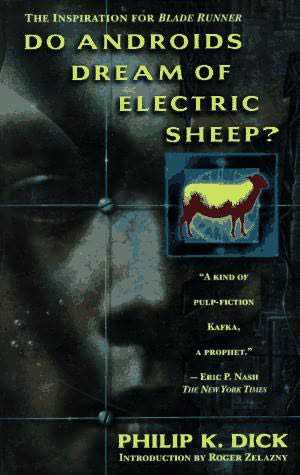
In 1968, Dick published Do Androids Dream of Electric Sheep? the story of a bounty hunter who polices the android population. It occurs on a dying, poisoned Earth. The androids have a preset death date, but some are seeking to escape this fate and supplant the humans on Earth. What is real? What is fake? Are the human-looking androids fake or real? Should they be treated as machines or as people? This book was made into the very good motion picture Blade Runner starring Harrison Ford in 1982.


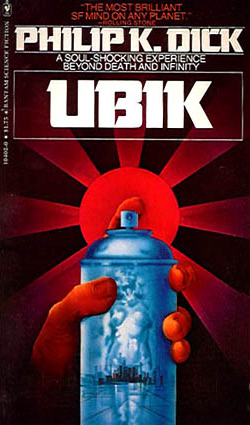
In Ubik, a group of psychics are sent to investigate a group of rival psychics, but several of them are apparently killed by a saboteur's bomb. Strange shifts in reality start to happen and things seem to be decaying. Messages start to appear in writing and television. Reality gradually shifts until the group finds themselves back in time to a world that resembles the US in 1939. In each time period they enter they find a mysterious product call Ubik which may be their only chance for survival.


Flow My Tears The Policeman Said, which was published in 1974, concerns a television star living in a dystopian near-future police state. After being attacked by an angry ex-girlfriend he awakes in a dingy LA hotel room. His identification papers are missing and he soon discovers that his whole identity has been erased. Nobody recognizes him now and he has no fame or reputation to rely upon. The themes of celebrity, genetic enhancement, altered reality, and drugs are interwoven into a narrative about the meaning of identity.


A Scanner Darkly, from 1977, is part science fiction and part police procedural. An undercover narcotics officer loses touch with reality after he becomes addicted to the same mind altering drug Substance D, he was enlisted to fight. Substance D begins with a pleasant euphoria but is quickly replaced with increasing confusion, hallucinations, and eventually total psychosis. Eventually the narcotics officer realizes he is investigating himself.


In February 1974, Philip K. Dick was recovering from the extraction of an impacted wisdom tooth in which he was given sodium pentothal. He answered his door to receive a delivery of more medication from the local drugstore. He noticed the delivery woman was wearing a pendant with a symbol that consisted of two intersecting arcs delineating a fish in profile. Vesicas Piscis was a secret symbol used by early Christians. After the woman left, Dick started experiencing strange visions. He described the initial visions as laser beams and geometric patterns, with pictures of Jesus and ancient Rome. He would see ancient Rome superimposed on California and felt that perhaps he was experiencing two separate realities at the same time. He believed he was living a double life - one as himself, Philip K. Dick, and one as Thomas, a Christian persecuted by Romans in the 1st century A.D. 


He felt his mind had been invaded by a transcendentally rational mind, as if he had been insane his entire life, and now suddenly he had become sane. He believed that an alien intelligence/technology, that could be God was communicating to him through an interface he called Valis - vast active living intelligence system. This system took the form of a ship in outer space that was delivering doses of information to him through beams of pink light. Dick wrote about these experiences, first in his semi-autobiographical novel Radio Free Albemuth and then in Valis, The Divine Invasion, and The Transmigration of Timothy Archer with these three titles becoming known as the Valis Trilogy. At this time in an attempt to understand the hallucinations and visions he was having, Dick also started an Exegesis that grew into thousands of pages. Besides being a mystical exegesis, it served as a daily diary, a prolonged self-analysis, and a dream journal. Some of it is published in The Shifting Realities of Philip K. Dick which is a collection of literary and philosophical writings.


In Radio Free Albemuth, a paranoid incompetent has schemed his way into the White House and has got America into a war against an imaginary internal enemy. A struggling science fiction writer named Philip K. Dick is trying not to become one of the war's casualities. His best friend Nicholas Brady is receiving transmissions from an extraterrestial entity that may also happen to be God - an entity that wants him to overthrow the President.


In Valis, a group of religious seekers forms to explore the visions of Horselover Fat. The group ends up on a rock musician's estate where they confront the Messiah: a two-year old named Sophia. She confirms their suspicions that an ancient, mechanical intelligence orbiting the earth that has been sending them information in the form of a pink laser light. It is written in a more autobiographical style based on Dick's visionary experiences.

The Divine Invasion, the second book of the Valis Trilogy, is more science fiction in its style than Valis. It asks - what if God is alive and in exile on a distant planet? How could a second coming succeed against the high technology and finely tuned rationalized evil of the modern police state?

The Transmigration of Timothy Archer is the final part of the Valis Trilogy and is more of a literary book about an Episcopal bishop who is haunted by the suicides of his son and mistress and goes on a bizarre quest for the identity of Christ. The character of Bishop Archer is loosely based on James Pike who in 1969 was found dead of exposure in the Judean Desert near the Dead Sea in the West Bank. This was Philip K. Dick's final book before his death from a stroke in 1982.

Philip K. Dick will expand your mind - you will never think of "reality" in the same way again.


Thursday, October 28, 2010

WERNER HERZOG


I first encountered the films of Werner Herzog as a college student in the 1970s. His 1972 feature Aguirre, the Wrath of God was the first film I watched and I found it hypnotic, eccentric, strangely beautiful, and emotionally powerful. This was the first of 5 films he would make with the German Actor Klaus Kinski, and also followed a Herzog theme of an obsessive central character who is at odds with society or nature or both.

Herzog emerged from the New German Cinema in the 1970s which included the filmmakers Wim Wenders, Rainer Werner Fassbinder, Volker Schlondorff, and Margarethe von Trotta. They wanted to make films that were artistically interesting rather than films that were dictated by commercialism. Herzog has always made both narrative features and documentaries. 

The strength of Herzog's work is in the layering of image and music,  creating an emotional experience and drawing the viewer into the film. His characters or subjects are often eccentric individuals and there is often dark humor in the dialogue or narration.


Aguirre, the Wrath of God takes place in the 1500s and follows a group of Spanish conquistadors moving down the Amazon searching for the legendary city of gold, El Dorado. It is based on some historical facts, but works more as a metaphor for man's thirst for power, the need to conquer others, and the madness and folly of trying to dominate nature.

The film was shot in the Peruvian rainforest, and starts with a long shot of the expedition moving down a mountain in the clouds, set to the music of Popol Vuh. Herzog holds his images on screen longer than most filmmakers and this gives them a hypnotic effect. Throughout the film the camera lingers on images of natural beauty in the rainforest. 

Aguirre, becomes the ruler of what is left of the expedition as they move down the river, slowly starving and suffering from hallucinations. Kinski plays him with an intensity and snarl that makes him frightening and intimidating as he descends into madness. He is full of eccentric dialogue including - 

" I will produce history, like others produce plays."

"If I want the birds to drop dead from the trees....the the birds will drop dead from the trees..."

"The earth I pass will see me and tremble."

In the end it becomes clear they are on a river to nowhere and after all of the other men are dead, Aguirre is left alone on a raft of monkeys as the camera swirls around him.

"I, the Wrath of God, will marry my own daughter and with her I will found the purest dynasty the world has ever seen. Together, we shall rule this entire continent. I am  the Wrath of God.

This is one of many films that Herzog made in difficult and treacherous circumstances.


Fitzcarraldo, also made with Kinski in the lead is about a man who wants to build an opera house in a small city in Peru. To do so he needs a lot of money and wants to get into the rubber business. To deliver his product he has to haul a 300 ton steamship across a mountain to another river tributary. Herzog actually did this in the filming, creating huge problems and injured crew members. Kinski and Herzog also fought a lot on the set of this film, and some of it is documented in Herzog's documentary My Best Fiend.

Another early feature, Even Dwarfs Started Small, concerns the story of a group of dwarfs confined to an institution on a remote island. They rebel against the guards and riot in total chaos. The dwarfs gleefully break windows, set fires, kill animals, and crucify a monkey.


In 1974, Herzog made The Enigma of Kaspar Hauser about a  man in the 1800s who lived his first seventeen years of his life chained in a tiny cellar with only a toy horse to occupy his time, devoid of all human contact except for a man in black who feeds him. One day the man leaves Kaspar in the town of Nuremberg. He becomes a curiousity, and is exhibited in a circus before being rescued by Herr Daumer who attempts to transform him. He learns to read and write, and develops unorthodox approaches to logic and religion, but music is what pleases him most. He attracts the attention of academics, clergy, and nobility. In the end he is attacked and then murdered by the man in black. In this film he uses the non-actor Bruno S., who also appeared in a later film Stroszek.

Another major film of Herzog's from this period was Heart of Glass made in 1976. It takes place in a Bavarian town with a glass blowing factory which produces a brilliant red ruby glass. When the master glass blower dies, the secret to producing the ruby glass is lost, and the town gradually sinks into disorder and madness. During the filming, the entire cast performed while under hypnosis.


In 1979, Herzog made his remake of Nosferatu, inspired by the 1922 F.W. Murnau version starring Max Schrek. Again, Herzog uses Klaus Kinski in the lead role. It is strange and funny at times and contains some beautiful cinematography put to the music of Wagner.

As I stated earlier Herzog has also made many documentaries. Two that stand out are from more recent times - Lessons of Darkness made in 1992, and Grizzly Man made in 2005. 


Lessons of Darkness resembles an earlier work Fata Morgana  where the desert takes on its own voice. Lessons of Darkness concentrates on the imagery of the aftemath of the first Gulf War - specifically the oil fires in Kuwait - although the film never mentions any relevant political or geographical information. There are helicopter shots of the bleak landscape. Herzog's minimal narration reinterprets the imagery out of its documentary context into a poetic fiction. The workers are described as creatures whose behavior is motivated by madness and the desire to perpetuate the damage that they are witnessing. There is a science fiction quality to the film as if it is not earth but an alien planet.


Grizzly Man, chronicles the life and death of bear enthusiast Timothy Treadwell. The film consists of Treadwell's own video footage of his interactions with grizzly bears in Alaska before he and his girlfriend were killed and eaten by a bear in 2003. There are also interviews with his friends and people from the area, as well as Herzog's commentary. Treadwell spent 13 summers at Katmai National Park and Preserve and over time believed he had become trusted by the bears as if he was one of them. He has names for them and got extremely close to them, even touching them at times. But many felt he was deluding himself and was putting himself and others in danger, which later proved to be true. He interviews himself at times and his mental state is cleary threatened at times. Herzog saw him as a disturbed individual who may have had a death wish.

There are many other wonderful films by Werner Herzog. These are just some that stood out for me. 

Werner Herzog has made films for over 40 years and they are some of the most interesting, innovative, and idiosyncratic works of cinema ever produced.


Wednesday, October 20, 2010

VINCENT VAN GOGH


"If a voice within you says you are not a painter, then paint my boy and that voice will be silenced."

In art school I read this statement in the letters of Vincent Van Gogh.

Vincent Van Gogh is one of my favorite painters and one of history's greatest artist. The Dutch post-impressionist had a huge impact on the modern movements that would occur in the 20th Century. He painted his world - the people and places of his own environment, in a style of slashing strokes of vivid color that created a highly emotional impact. Van Gogh suffered from anxiety and mental illness, and died unknown, at the age of 37, from a self-inflicted gunshot wound.

He produced more than 2,000 artworks, consisting of around 900 paintings, and 1,100 drawings and sketches. He didn't start painting until his late twenties, and most of his best-known work was produced in the last  two years of his life. Unknown and having nothing when he died, his work is now worth millions of dollars.

At one point, Van Gogh desired to be a pastor, and from 1879 he worked as a missionary in a mining region in Belgium. He sketched the people in the local community, and in 1885 painted his first major work The Potato Eaters. He used mostly somber earth tones and showed no sign of the vivid coloration that distinguished his later work. In 1886, he moved to Paris and discovered the French Impressionists. Later he moved to the south of France and was inspired by the strong sunlight he found there. During his stay in Arles in 1888, he fully realized his unique and highly recognizable style.

How his mental illness affected his art has been a subject of speculation and controversy. Some see the mental illness as an explanation for the electric color and vibrating strokes of paint. Others feel he was actually frustrated by his illness, as it made it difficult for him to work when he was having an episode.

In 1885, he lived in Antwerp and liked the bold color he saw in the paintings of Peter Paul Rubens and started collecting Japanese woodcuts and started incorporating them into some of the backgrounds of his paintings. During his stay there he started drinking absinthe heavily, and became ill and run down from overwork, a poor diet, and excessive smoking.

He travelled to Paris in 1886, and was exposed to the work of Monticelli, Toulouse-Lautrec, Cezanne, Seurat, Monet, Degas, and Pissaro, among others. In November of 1887, Vincent and Theo met and befriended Paul Gauguin. Van Gogh had become worn out from life in Paris, even though he had created over 200 paintings in his two year stay there.


Van Gogh moved to Arles hoping for refuge. He found it a strange and exotic place. In one of his letters he describes the people who all drank absinthe, as creatures from another world. He was inspired by the local landscape and light, and his paintings from this period were intensely colorful using yellow, ultramarine, and mauve. Paintings from this period included The Red Vineyard, The Night Cafe, The Postman, Van Gogh's Chair, Bedroom In Arles, Starry Night Over The Rhone, and Still Life: Vase With 12 Sunflowers.


After repeated requests, Gauguin finally arrived in Arles in October. During November they painted together but they argued about art all of the time, and Van Gogh felt an increasing fear that Gauguin would desert him. Van Gogh confronted Gauguin with a razor blade, but then in a panic left their quarters for a local brothel. He cut off the lower part of his left ear and wrapped it in newspaper and left it with a prostitute named Rachel. He told her to "keep this object carefully." Gauguin left Arles and never saw Van Gogh again. Van Gogh was hospitalized and when he returned home suffered from hallucinations and delusions that he was being poisoned. In March, 1889, police closed his house because of complaints by the townspeople who referred to him as the "redheaded madman." Two months later he left Arles for Saint-Remy-de-Provence.


He committed himself to a hospital that was a former monastery, 20 miles from Arles, located in an area of  cornfields, vineyards, and olive trees. Theo arranged for two small rooms - adjoining cells with barred windows. The second was to be used as a studio.

The clinic and the garden became the main subjects of his paintings. Some of the work from this period was characterized by swirls - including his masterpiece The Starry Night. He was allowed to take short supervised walks which gave rise to the paintings of cypresses and olive trees. This led to a shortage of subject matter, so Van Gogh did some work based on other artists such as Millet's The Sower at Noon.


In May 1890, Van Gogh left the clinic ot live near the physician Dr. Gachet and be closer to Theo. He did portraits of the doctor and also Wheat Fields With Crows an amazing work where he used a double square canvas to create a panoramic landscape. This is one of his last works and has a dark and turbulent quality. In 1986, the Met had an exhibition centered around the work from this period and I was able to see Wheat Field With Crows in person. 


It is a painting that can be interpreted in different ways. Some see it as an image of cosmic chaos projected through Van Gogh’s inner torment, a psychic graph of his imminent suicide. The troubled skies represent the tragedy of the modern world, it’s failures, despair, and the pathetic situation of the human condition. The suffering soul of man hanging and torn between two poles - one in contact with evil and the other reaching to the heavens. Even though he looked outside of himself for the subject of his paintings, the work expresses the terrible image of his soul. Ordered chaos, frustration, and the endless search, never arriving at any destination. 

Others saw the painting in a more positive light. Van Gogh believed in the restorative forces of landscapes, and the center path of the painting leads the eye through the field converging to infinity. The wheat is ripening under the menacing sky and the crows are flying away free and transcendent.

His depression got worse, and on July 27, 1890 he walked into a field and shot himself in the chest with a revolver. He was able to walk back to the Inn where he was staying, but died on July 29, 1890. Theo reported his brother's last words were " the sadness will last forever."

Vincent Van Gogh was a self-taught artist who created an amazing body of work at a frantic pace late in his life. The paintings are powerful, and haunting and reflect both the beauty and turmoil of life.