Recently, I saw Socialism (Film Socialisme), the latest film by the 80-year old Jean-Luc Godard. Like most of Godard's work, as opposed to telling a linear narrative, the film is a collage of images, sounds, quotations, meditations on history and politics, and references to film history. The film is full of beautiful cinematography and includes digital HD, low tech camera-phone video, shifting seascapes, historic footage, and title cards.
The film is structured as a symphony in three movements. In the opening section a group of characters wander a cruise ship and we catch clipped, cryptic conversations in multiple languages about imperialism and genocide, that are subtitled in fragments. Patti Smith and a man appear and break into song. A French philosopher delivers a lecture on geometry to an empty ballroom, poking fun at cruise-line educational offerings. A teenage girl watches YouTube clips of meowing kitties, which is linked to the ancient status of cats in Egypt, one of the journey's six stops that occur in the third movement. There is a scene in the ship's disco that depicts people swaying to the harsh, jittery, dance music called "glitch."
The middle section takes place at a French gas station , where politics, TV journalism, and children's skepticism about their parents are investigated. There are elegant compositions and humorous absurdist touches as the family has a pet llama and a donkey on the premises.
The final section is composed of quick-cut, free associating montages that are reminiscent of Godard's video work. He incorporates images from Eisenstein's Potemkin, and reflections on war, imperialism, and liberation as the ship visits six legendary sites: Egypt, Palestine, Odessa, Hellas, Naples, and Barcelona.
The film makes extraordinary use of music and sound. Beethoven, Part, Schnittke, Chet Baker, and silence work with and against the images of glistening watery decks and Rembrandt-lighted interiors. When watching a Godard film you have to discard all accepted expectations of what a film is or should be and give in to the flow of images, sounds, and ideas that will keep you thinking long after you have left the theater.
Godard is French-Swiss and was a film critic with the film magazine Cahiers du Cinema that laid the groundwork for a set of concepts that formed the auteur theory, where the director is seen as the central artist, or author, in the construction of the work, and produces a personal signature from film to film. Francois Truffaut, Eric Rohmer, Claude Chabrol, and Jacques Rivette were all critics at Cahiers, and along with Godard all went on to make films and became known as the French New Wave (Nouvelle Vague). They praised the films of Jean Renoir, Jean Vigo, and Robert Bresson and the Hollywood directors Orson Welles, John Ford, Alfred Hitchcock, Howard Hawkes, Samuel Fuller, and Nicholas Ray, among others.
The 400 Blows (1959) by Truffaut, Hiroshima Mon Amour (1959) by Alain Resnais, and Breathless (1960) by Godard shot the New Wave into international prominence and were unexpected financial and critical successes and allowed the movement to flourish.
Godard is the most extreme and radical of the New Wave filmmakers. His films challenged the conventions of traditional Hollywood cinema as well as traditional French films that were based on literary classics. His films combine political ideologies, knowledge of film history, and existentialist philosophy.
Godard was also influenced by the German playwright Bertolt Brecht and believed in his theory of alienating or distancing the viewer from the work by using a radical separation of the elements of the medium. Godard wanted his work to deny the viewer a fluid narrative typical of mainstream cinema and force the viewer to take a more critical role and connect the pieces themselves, coming away with more investment in the film's content.
Breathless (A Bout de Souffle) was Godard's first feature length film and starred Jean-Paul Belmondo and Jean Seberg. Breathless used a bold visual style by mixing longer takes with quick cutting, and used jump cuts that broke the traditional film continuity. Godard wanted the viewer to be aware that they were watching a film, or an artistic constuction, but Breathless along with other of his earlier films still had a loose story structure and provided many pleasurable moments. Even though there is a crime element in it, the film has a light, jazzy quality.
Michel (Belmondo) is a petty criminal who models himself after Humphrey Bogart. He steals a car in Marseille and shoots a policeman who follows him on a country road. He goes to Paris and turns to his American girlfriend Patricia (Seberg), a student and aspiring journalist, who sells the New York Herald Tribune on the streets. She hides him in her apartment while he tries to seduce her, but the police move in, leading to the film's conclusion.
Breathless is one of cinema's major works because it took the language of film and exploded it with a variety of radical new techniques, that included hand-held camera work, off-beat editing, and allusions to popular culture and references to art and film history.
Breathless was the first of several films of international art house works by Godard that brought him acclaim and would continue through 1967. Le Petit Soldat (The Little Soldier) dealt with the Algerian War of Independence and was the first collaboration between Godard and the actress Anna Karina (who he married in 1961 and divorced in 1967). The film was made in 1961, but because of its political nature it was banned by the French government until 1963. A Woman Is A Woman (1961) also starred Karina, this time with Belmondo, and was an homage to the American musical.
Vivre sa Vie (My Life To Live) came out in 1962 and starred Karina as Nana, an errant mother and aspiring actress, who to make ends meet, becomes a prostitute. She is constantly trying to prove she is free even though her life is controlled by a pimp. The film like Breathless used a camera-liberated experimentation that marked the style of the French New Wave.
Les Carabiniers (1963) was about the horror of war and its inherent injustice and was inspired by the work of Roberto Rossellini.


Le Mepris (Contempt) also came out in 1963 and was Godard's most commercially successful film. It was based on the novel by Alberto Moravia. It starred Brigitte Bardot, along with Michel Piccoli and the American actor Jack Palance. It was a French-Italian co-production and was the pinnacle of cinematic modernism. It is shot in color in wide-screen cinemascope and is full of beautiful compositions. It deals with both the problems of relationships and in the making of films. The film follows Paul (Piccoli), a screenwriter who is hired by the arrogant American producer Prokosch (Palance) to rewrite the script for an adaptation of Homer's Odyssey, which is being directed by the great Austrian-American filmmaker Fritz Lang. Prokosch doesn't understand Lang's high art interpretation and only wants a commercial success. " When I hear the word culture, I get out my checkbook." Palance portrays Prokosch as a shallow bully, almost gangster-like, who is only concerned with the bottom line, and this makes Contempt an indictment of the motion picture hierarchy. Bardot plays Camille, Paul's wife and the film details the disintegration of their marriage because she sees him as weak, compromising, and a sell-out. She loses respect for him and her love is transformed into contempt.
Contempt has several stunning sequences and many radical cinematic techniques. In the opening shot we see the cinematographer Raoul Coutard operating the camera as it tracks from a distance in closer until it points at us, the audience, as the credits are being told through overvoice on the soundtrack. There is a long scene with Bardot in the nude lying in bed with Piccoli. The light changes from red, to naturalistic, to blue with the use of filters. There is an extensive sequence in an apartment where Paul and Camille argue and move around constantly, getting dressed, undressed, sitting on toilets, taking baths, and the door frames and walls are physical barriers between the couple as their relationship falls apart. The film also makes use of flash-memory jump cuts showing the characters at different points within the film. A modern house along the sea on the island of Capri with multiple steps to the rooftop is the setting for the final act as the relationship between Paul and Camille and the making of the film all reach a startling climax. Contempt is a beautiful, thought-provoking film and ends with a shot where the frame is divided into water and sky. At one point in the film Lang remarks, "To live is to suffer."
Band of Outsiders (Band a Part) came out in 1964, and starred Karina. Godard described it as Alice In Wonderland meets Franz Kafka. It follows two young men who both fall in love with Karina as they look to score a heist. There are many references to American gangster films. A Married Woman (Une Femme Mariee) also came out in 1964 and was a slow, deliberate narrative in black and white about a married woman who chooses between her husband and her lover.


In 1965, Godard directed Alphaville, a futuristic blend of science fiction, film noir, and satire. A detective named Lemmy Caution played by Eddie Constantine is sent into a city controlled by a giant computer name Alpha 60, with the intention of overthrowing the dictatorial computer. Even though it is set in a dystopian future, there are no special effects as the city of Paris is filmed as the futuristic city. Alpha 60 outlaws free thought and individualist concepts like love, poetry, and emotion. People who show emotion are considered illogical and are gathered up, interrogated, and executed. Alphaville is an inhuman, alienated society of mindless drones.

Belmondo and Karina starred in Pierrot Le Fou in 1965. The plot is less minimal than earlier Godard films and involves a man who leaves his family and flees with a girlfriend who is being pursued by gangsters. Like many of Godard's films the characters break the fourth wall by looking into the camera. There are a lot of references to the Pop Art movement with the use of bright primary colors and visuals drawn from cartoons. It mixes high and low art and uses the collage-like narrative structure that dissects popular cinematic conventions.
Masculin, Feminin (1966) was a study of contemporary French youth and their involvement in cultural politics. An intertitle refers to them as The Children of Marx and Coca-Cola. The film is based on two Guy de Maupassant stories and stars Jean-Pierre Leaud as Paul, a young romantic writer who chases a budding pop star named Madeleine (Chantal Goya). Despite their different tastes in music and politics they become romantically involved and begin a "menage a quatre" with Madeleine's two roommates. The film depicts a series of verite-style interviews about love, love-making, and politics. There are many references to pop culture icons and political figures of the time including Charles de Gaulle, James Bond, and Bob Dylan.

Made In USA (1966) was inspired by the Howard Hawkes film The Big Sleep and is loosely based on the novel The Jugger by Richard Stark. Because of legal reasons it wasn't seen in the US until 2009. Anna Karina plays a female version of Bogart's hard boiled detective and goes to Atlantic City to meet her lover. When she finds out he is dead, she decides to investigate and has various encounters with gangsters.

Marina Vlady plays a housewife leading a double life as a prostitute in Two or Three Things I Know About Her (1967). It is a disturbing character study of married women with children whose husbands agree and/or encourage their wives to sell their bodies to maintain a high standard of living. They live in a modern high rise in box-like, alienating rooms that Godard felt promoted a value system of consumerism. The film cuts to still shots of brightly colored products and urban construction. Godard does the voice-over as a self-questioning narrator and discusses his fears about the contemporary world and makes reference to the Vietnam War.
Le Chinoise (1967) saw Godard at his most political as he focuses on a group of activist students in contemporary France. It was released just prior to the student rebellions of May 1968. The film is loosely based on Dostoyevsky's novel The Possessed that is about five disaffected citizens who each represent a different ideological persuasion and personality type and conspire to overthrow the Russian imperial regime. Godard's film is set in Paris in a small apartment and dramatizes the interactions of five French students through a series of personal and ideological dialogues who belong to a radical Maoist group.


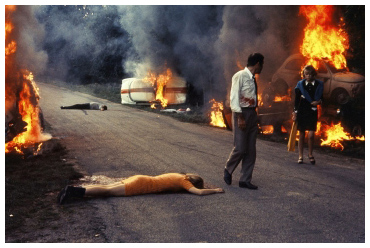
Weekend (1967) is a black comedy that follows a French couple who both have lovers and are both planning each other's murder. They set out for the country home of the wife's father to secure their inheritance even if it means killing him. The journey is full of bizarre characters and punctuated by violent car accidents. After their own car is destroyed, they wander through a series of vignettes involving class struggle and figures from literature and history. It creates a beautiful, but also senseless and disturbing world. Intertitles pop up commenting on the narrative. Weekend has a single tracking shot that lasts for over 8 minutes and follows a car moving slowly through a massive traffic jam. The bodies of a family lie across the road in stark contrast to the beeping horns of the frustrated drivers who are trying to pass. The couple arrives at the parents home only to find that the father has died and the mother refuses them a share of the spoils. They kill her and set off on the road again and encounter a group of hippy revolutionaries who support themselves through theft and cannabalism.
Weekend was Godard's 15th feature and marked the end of his first major cinematic period. Politics are never far from the surface of Godard's films, but after Weekend and the events of May 1968, he made a conscious decision to make films that were even more radical and political, both in content and form. France was now seen by the left as an authoritarian de Gaulle republic, and Godard decided to work with like-minded individuals on his films. The most notable was Jean-Pierre Gorin who was a young Maoist student and they formed a film collective under the name The Dziga Vertov Group. Vertov's name is derived from the verb to spin or rotate and worked at the same time as the Soviet montage theorist Eisenstein and constructivist and avant-garde artists such as Rodchenko and Tatlin. Godard was now making a political shift towards a proactive participation in the class struggle.
The group made several films between 1968 and 1972 including One Plus One, British Sounds, and Wind From The East. The films are hard to see because they were so radical. They were collages of document and staged scenes and had limited theatrical releases. One Plus One was later released as Sympathy For The Devil and includes several long takes of the Rolling Stones in a sound studio recording their famous song. The recording sessions are intercut with staged footage of Black activists reading revolutionary texts and dispensing weapons at a waterfront auto junkyard, as well as voice-over of a man reading a porno novel, other scenes of a young woman writing graffiti with word play, and still other scenes dealing with Marxism and the need for revolution.
Also made at this time was Le Gai Savoir (1969) which is set on a darkened soundstage as two actors Jean-Pierre Leaud and Juliet Berto discuss the philosophy of making films and play word-association games. There are scenes of the Paris student revolt, the Vietnam War, along with posters, photos, and cartoons in the background. The soundtrack includes narration, music, news clips, and noise resulting in a montage and meditation on how word and images mix and questions the filmmaking process.

In their final works the Dziga Vertov Group went back to using well-known actors and produced the film Tout Va Bien (Everything's Fine) starring Jane Fonda and Yves Montand. The film centers on a strike at a sausage factory witnessed by an American reporter and her French husband who is a film director. It presents a Marxist political message explaining the logic of class struggle. At the same time they made Letter To Jane, an essay film which deconstructs a photograph of Fonda visiting Hanoi during the Vietnam War. It questions what is the role of a celebrity and intellectual when getting involved in the class struggle.

At this point Godard started to experiment with video and created several works, most notably the film Numero Deux which came out in 1975. It was a collaboration with the Swiss filmmaker Anne-Marie Mieville who Godard would work with on many projects in this period. The film is about a young family in social housing complex in France. The film uses a distinct style, presenting two images on screen simultaneously, leading to multiple interpretations of the story and comments on the filmmaking process.
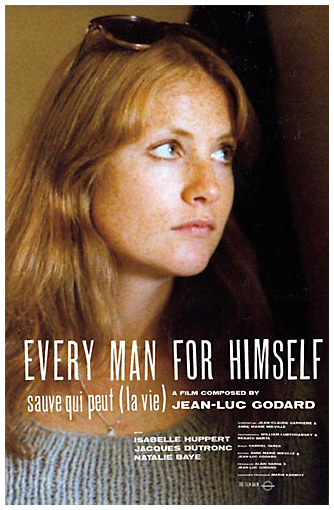
In 1980, Godard returned to more traditional filmmaking by releasing Sauve qui peut (la vie), also released in English as Slow Motion and Every Man For Himself. It starred Isabelle Huppert, Nathalie Baye, and Jacques Dutronc and continues many of the themes dominant in Godard's work including prostitution and the director's constant self-questioning. Dutronc plays a burned-out video filmmaker named "Godard."
Other films from this period included Passion (1982), Phenom Carmen (1984), Detective (1985), and King Lear (1987).
The most controversial film to come out of this period was Hail Mary (1985), which is a modern retelling of the story of a virgin birth. Marie, a student works at her father's Swiss gas station and plays basketball, and maintains a chaste relationship with Joseph her taxi driver boyfriend. A passing stranger arrives by jet plane and informs her she will become pregnant and give birth to the son of God. At first she is shocked and confused, but eventually comes to terms with God's plan through meditations that are interwoven with images of the sun, the moon, clouds, flowers, and water. The use of full frontal nudity and the religious themes upset many Christians and sparked some protests at screenings.

After this Godard continued to work in both video and film and produced work for French television. In the 90s he produced several works including Nouvelle Vague (1990), the autobiographical JLG/JLG (1995), Forever Mozart (1996), and his massive work Histoire(s) du cinema, which combined all of the innovations of his video work with a passionate engagement with the issues of 20th century history and the history of film itself. It was started in the late 1980s and the final part completed in 1998.
Since the turn of the century, Godard has continued to make films including Eloge de l'Amour (In Praise of Love) in 2001, and combines both film and video. In Praise of Love deals with the themes of aging, love, separation, and rediscovery as we follow a young artist contemplating a new work on the four stages of love.
Notre Musique (2004) is about war, specifically the war in Sarajevo, but with attention to all wars, including the American Civil War, the war between the US and Native Americans, and the Israeli-Palestinian conflict. The film is structured into three kingdoms: Hell, Purgatory, and Paradise. The film opens with a long montage of war images set to the music of Kurtag. Paradise is shown as a lush wooded beach patrolled by US Marines.
Is Film Socialisme Godard's final film? His influence is vast and can be seen in the works of Tarantino, Scorsese, Bertolucci, Penn, Linklatter, Altman, Jarmusch, Fassbinder, and Wenders. He has made an amazing body of work and created a legacy of radical experimentation. He has investigated the process of filmmaking more than any other director, while making statements about the history and culture of our society.